
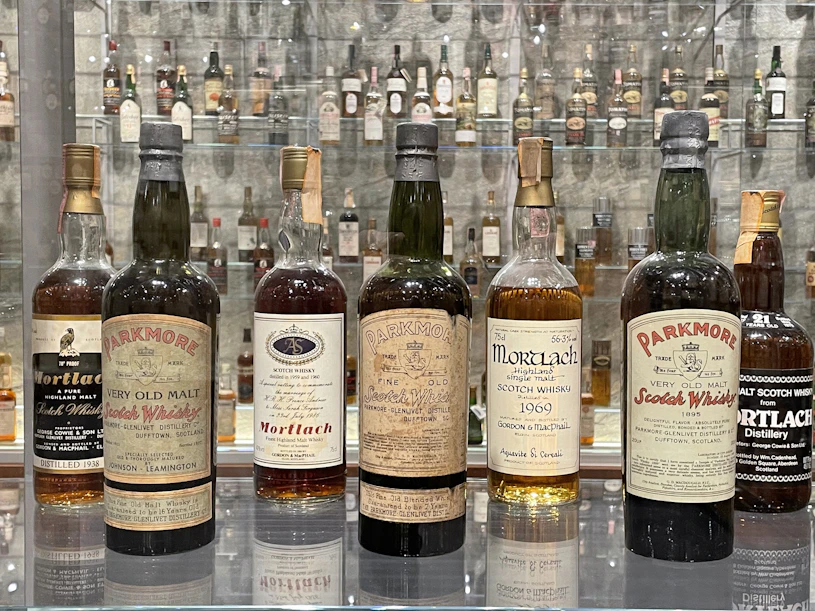
Parkmore Distillery: The Story of a Speyside Ghost
Parkmore is a single malt distillery in Dufftown (Speyside) that was active for only about 35 years before production came to a halt. Although silent since 1931, the distillery buildings still stand and remain in remarkably good condition. During its active years, Parkmore’s whisky was mainly used for blending, including Baxter’s Barley Bree and Watson’s No. 10 from James Watson & Co. It may also have contributed to some of Dewar’s blends.
Region: Speyside
Founded: 1894
Status: Mothballed, buildings used for storage
Current owner: Edrington
Visitor centre: No
Why Parkmore Is Special
A well-preserved piece of industrial heritage: Parkmore is one of the best-preserved silent distilleries in Scotland and an outstanding example of Victorian distillery architecture in Dufftown.
Historical blends: Parkmore’s whisky was used in some of the most notable blends of the early twentieth century, giving the distillery lasting historical value.
Rarity: Authentic Parkmore bottles are extremely scarce. When they appear at auction, they attract strong interest from collectors worldwide.
A Brief History of Parkmore
Parkmore was built in 1894 by the Parkmore Distillery Company during a boom period for the Scotch whisky industry. It became one of the original “seven stills of Dufftown.” The economic crash of 1898, caused by the collapse of Pattison’s, led to a series of ownership changes.
1894: Parkmore Distillery Company opens a distillery near Glenfiddich.
1900: Acquired by Dundee blender James Watson & Co.
1923: James Watson & Co is sold to Buchanan-Dewar and John Walker & Sons. John Dewar & Sons takes over the operation of Parkmore.
1925: Buchanan-Dewar is absorbed by Distillers Company Limited (DCL).
1930: Parkmore is transferred to DCL’s subsidiary, Scottish Malt Distillers.
1931: The distillery is closed and mothballed.
1940: Licensed to Daniel Crawford & Son Ltd for storage, though production was never resumed.
1988: The site is sold to Highland Distillers (now Edrington) for storage purposes.
1999 – present: Edrington remains the owner and continues to use the buildings for storage.
Ownership Timeline
Parkmore Distillery Co (1894–1900)
James Watson & Co (1900–1923)
John Dewar & Sons (1923–1925)
Distillers Company Ltd (1925–1940)
Daniel Crawford & Son (1940–1988)
Highland Distillers (1988–1999)
Edrington (1999–present)
Production and Whisky
Parkmore produced single malt whisky used primarily for blending. There are no official bottlings, and independent releases are extremely rare. Any Parkmore bottles appearing on the market require careful verification due to their scarcity.
Parkmore Today
The Parkmore buildings still stand in Dufftown and are used by Edrington for storage. There is no visitor centre, and no production takes place. Architecturally, Parkmore remains one of the best-preserved examples of the Speyside distillery boom of the 1890s.
A unique detail is that three original bottles from Parkmore are part of the collection at the Valentino Zagatti Museum in Sassenheim, where Scotch Whisky Investments manages one of the largest whisky collections in the world. These rare bottles offer a tangible glimpse into the distillery’s history and stand as valuable evidence of Parkmore’s enduring legacy.
Learn More About Investing in Whisky
The world of whisky tells a story not only of craftsmanship and tradition but also of value creation over time.
Would you like to discover how whisky can contribute to diversification and long-term growth within your portfolio?
Contact Scotch Whisky Investments or request our whitepaper to gain deeper insights into investing in rare and exclusive Scotch single malts.
Key Facts at a Glance
Location: Dufftown, Moray
Region: Speyside
Production type: Single malt for blending
Status: Silent since 1931
Buildings: Still in use for storage
Visitor centre: Not open to the public
Frequently Asked Questions
What is a ghost distillery?
A ghost distillery is one that is no longer operational, though some original stock may still exist. Such whiskies are rare and highly sought after.
Are there any official Parkmore bottlings?
There are no regular releases. Occasionally, a historic bottle appears at auction.
Can I visit Parkmore?
No, the site is not open to visitors and is used exclusively for storage.