Whisky ETF: does it exist and what are the alternatives?
There is no whisky ETF or index fund that invests directly in physical whisky. Discover how the whisky market works and how you can invest in whisky.

Stijn de Smit · 8 June 2026 · 7 min read
The WSKY ETF: there was once something similar
In October 2016, the American firm Spirited Funds/ETFMG launched the Whiskey and Spirits ETF, listed on the NYSE under ticker WSKY. The fund consisted of approximately 23 stocks in listed drinks companies including Diageo, Pernod Ricard, Brown-Forman and LVMH.
Important to understand: this was not an ETF in physical whisky. It was an equity fund with exposure to the broader drinks industry. Buying WSKY meant indirectly owning shares in large producers, not maturing casks or rare bottles. The price was determined by the stock market performance of those companies, not by the value development of whisky itself.
The fund launched at 25 dollars per share and grew to over 30 dollars in its first months. With assets under management of just 4.5 million dollars it remained a niche product. The WSKY ETF no longer exists in its original form and has since been withdrawn from the market.
The conclusion remains the same: an ETF that invests directly in physical whisky has never existed and does not exist today.
Why does a whisky ETF not exist?
An ETF (Exchange Traded Fund) is a listed fund that tracks an index or group of assets and is tradeable on the stock exchange on a daily basis. A whisky ETF would mean a fund that invests directly in physical whisky and that investors can buy or sell at any moment.
That is not possible for three structural reasons:
1. Whisky is physical and illiquid A maturing cask sits in a bonded warehouse in Scotland and cannot be traded from minute to minute. Value development depends on maturation over years, not on daily market movements. A cask bought today will not reach optimal selling condition for five to ten years.
2. There is no central exchange for whisky Equities and bonds are traded on regulated exchanges with transparent, continuous price discovery. Whisky is traded through auction houses, private sales and specialist platforms such as THE SWEX. Prices are established per transaction, not via a continuous order book. That makes a listed ETF structure practically impossible.
3. The investment horizon is fundamentally different ETFs are designed for liquid, short-term trading. Whisky requires a horizon of at least five to ten years to realise value development through maturation. An investor who wants to exit after six months faces a real risk of loss. The two are structurally incompatible.
Can I invest indirectly in whisky through equities?
A frequently asked question: what if I buy shares in a company that produces whisky? That is technically possible, but it does not provide direct exposure to the value development of rare whisky.
The largest listed whisky companies are:
Diageo (owner of brands including Johnnie Walker, Talisker, Lagavulin)
Pernod Ricard (owner of The Glenlivet and Chivas Regal)
Brown-Forman (owner of Jack Daniel's and Woodford Reserve)
The problem: the share price of these companies is determined by revenue, profit, debt, dividend policy, acquisitions and macroeconomic factors. Whisky is only one part of their total portfolio. A rise in rare whisky bottles at auction does not automatically translate into a higher share price for Diageo.
Anyone who genuinely wants to benefit from the value development of rare whisky needs direct ownership of the physical assets themselves.
How can you track the whisky market?
Although no whisky ETF exists, there are indices that provide market insight. These are the two you need to know:
1. WhiskyStats The most comprehensive data source for the whisky market. WhiskyStats brings together both primary and secondary transaction data in indices at multiple levels:
Region: Speyside, Islay, Highlands, Campbeltown
Country: Scotland, Japan, Ireland, America
Distillery: per individual distillery, including closed distilleries
The broad Scotland index shows a rise of 104% from January 2013 to January 2026, averaging 5.6% per year. For the scarce 25-plus segment, returns are structurally higher. Anyone who wants to follow the market seriously uses whiskystats.com.
2. Knight Frank Luxury Investment Index (KFLII) The most widely cited reference for luxury assets worldwide, published annually in the Knight Frank Wealth Report. The KFLII for rare whisky shows a rise of +111.9% over ten years (2015-2025). The index tracks the top cohort of the rarest bottles. Over 2025 the index showed a correction of -10.9% on an annual basis, a reminder that whisky does not rise linearly. The 10-year performance nonetheless holds up.
Whisky ETF vs physical whisky: the comparison
Whisky ETF
Does not (longer) exist
Daily tradeable on the stock exchange
Indirect ownership via an equity fund
High correlation with equity markets
Value development dependent on stock performance of drinks companies
Low minimum investment
Exchange regulated
Physical whisky
Does exist, via a specialist manager
Illiquid, investment horizon of at least 5 to 10 years
Direct, tangible ownership of casks or bottles
Low correlation with equity and bond markets
Value development driven by scarcity and maturation
Minimum investment from 100,000 euros (at Scotch Whisky Investments)
Via licensed manager (AFM)
What is the alternative to a whisky ETF?
Anyone who wants to benefit from whisky value development does so through direct ownership of physical whisky: maturing casks or rare bottles. That is fundamentally different from an ETF, but also offers something an ETF can never provide: tangible, real ownership of a scarce asset with intrinsic value and low correlation to equity markets.
Investing in whisky casks A maturing cask is a living product. Volume decreases through evaporation (averaging 2 to 3% per year, the so-called angel's share) while complexity and rarity increase. Scotch Whisky Investments focuses exclusively on the segment above 25 years, where only 0.7% of all Scotch single malt ever reaches. Ownership is recorded via a delivery order, registered with UK customs (HMRC).
Investing in whisky bottles Rare bottles offer more liquidity than casks. They can be traded through auction houses, private sales or via THE SWEX, our specialist trading platform. Prices are transparently tracked via WhiskyStats and whiskybase.com. The focus is on rare Scotch single malts from premium brands such as Macallan, Springbank, Ardbeg and closed distilleries including Brora and Port Ellen.
Read more on our page investing in whisky.
Risks of investing in whisky
Anyone considering investing in physical whisky should also understand the risks:
Illiquidity Whisky is not a liquid investment. Selling a cask outside the regular sales window carries a real risk of loss. The investment horizon is at least five to ten years.
No guaranteed return Past performance does not guarantee future results. The whisky market also has corrections, as the KFLII decline of -10.9% in 2025 illustrates.
Currency risk Whisky is stored and traded in Scotland in British pounds (GBP). For international investors, EUR/GBP or USD/GBP fluctuations play a role in the final return.
Storage costs Storage costs for a cask in a bonded warehouse average a few hundred pounds per year. These are regular costs that are communicated transparently at the start.
Whisky as an alternative investment: what can you expect?
Investing in physical whisky through Scotch Whisky Investments is aimed at high-net-worth individuals with an investment horizon of at least five to ten years. The minimum investment is 100,000 euros.
Based on historical data, the value development of rare whisky averages between 6% and 11% per year. Our own portfolios achieved an average of 10.6% per year over 2018-2025. Past performance does not guarantee future results.
Scotch Whisky Investments was founded in 2002, operates under regulatory oversight of the Dutch Authority for the Financial Markets (AFM) and manages over 350 million euros for more than 1,600 clients from its own bonded warehouses in Glenrothes, Scotland.
Frequently asked questions
Does a whisky ETF exist?
No. There is no listed whisky ETF or index fund that invests directly in physical whisky. Whisky is an alternative, non-listed investment category. Direct exposure to the whisky market always goes through physical casks or bottles, preferably via a specialist, regulated manager.
Is there a whisky index fund?
No, a whisky index fund does not exist either. There are however indices that track the market, such as the WhiskyStats Scotland index and the Knight Frank Luxury Investment Index. These are data sources for price development, not investment funds.
Can I invest indirectly in whisky through equities?
Indirect exposure via equities in drinks companies such as Diageo or Pernod Ricard is possible, but does not provide direct exposure to the value development of rare whisky. The share price of these companies is determined by many more factors than whisky value alone.
How do I invest in whisky then?
Through direct ownership of physical casks or bottles. Scotch Whisky Investments has guided high-net-worth individuals in this since 2002, under regulatory oversight, with a minimum investment of 100,000 euros. Get in touch for a no-obligation conversation.
What are the risks of investing in whisky?
The main risks are illiquidity (whisky cannot be sold quickly), no guaranteed return, currency fluctuations (EUR/GBP or USD/GBP) and annual storage costs. Whisky is a long-term investment in which losses are also possible.
Read more
Related articles
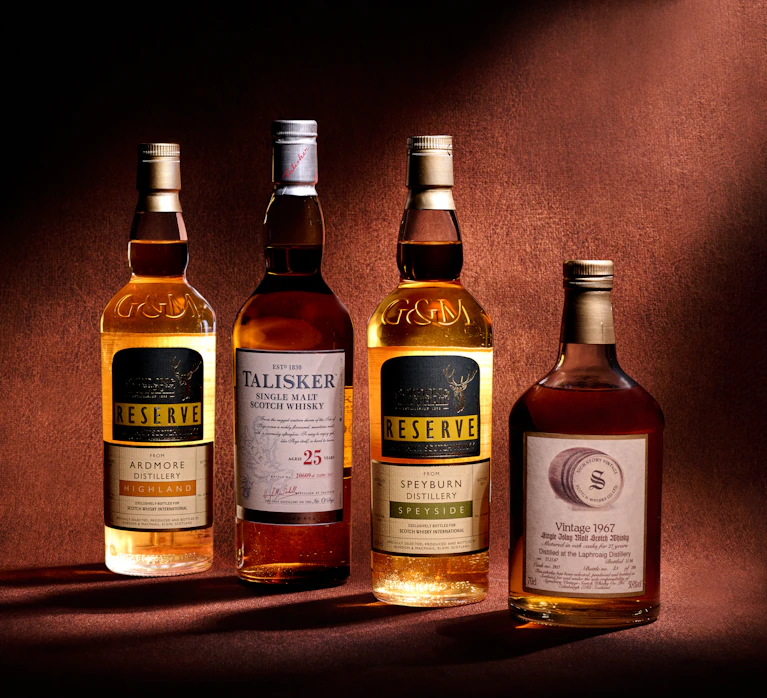
If you are considering investing in whisky, you are in the right place. On this page we explain what investing in rare Scotch single malt whisky involves, why scarcity and maturation are at the core of value development, and what you can expect in terms of return, risk and time horizon.
Read article
A Whisky investment you can trust
Considering recent discussions about questionable whisky investment schemes, we’d like to reaffirm what truly sets Scotch Whisky Investments apart.
Read article

Wealth growth, India and whisky as an investment
What the Knight Frank Wealth Report 2026 and the UK-India trade agreement mean for investors in Scotch single malt whisky.
Read article
Ready to start investing in whisky?
Schedule a no-obligation call with one of our whisky experts.