

Whisky half-year update 2026: the market floor takes shape
Since 2002 we have built whisky portfolios for more than 1,600 investors, with over 350 million euros under management. That gives us a direct, inside view of the market. Our conclusion on H1 2026 is clear: after three years of correction, the whisky market appears to have reached its floor. We promise no rapid rise, but in our view the correction phase is behind us.

Stijn de Smit · 17 August 2026 · 16 min read
- Single malt
- Investing
- Whisky
The whisky cycle: where do we stand?
The whisky market moves through recognisable phases. Following strong growth between 2018 and 2022, a correction phase set in, which we describe internally as phase 3: Decline and Correction. Prices normalised, volumes fell, and sentiment turned. That is a familiar pattern for alternative and illiquid asset classes.
Phase 4, Base-building and Recovery, announces itself when corrections level out, volume stabilises, and early positive signals accumulate. Historically, a consolidation phase in the whisky market lasts 18 to 24 months; 2025 and 2026 lay the foundation within that window. As we outlined in October 2025, the market is gradually regaining its footing. H1 2026 provides the first cautious confirmation of that transition.
We use this phase framework as a guideline, based on historical market movements and complemented by the current market situation, the outlook, and the data we track continuously. Our reading is clear: the market appears to be making the transition from correction to base-building. For the long-term investor that is the moment to build positions with discipline. We do not forecast rapid growth; we position for where the cycle stands.
"Liquid assets" move together
Whisky belongs in the broader category of luxury collectables, alongside fine wine, watches, and art. We use that comparison as a reference frame for the whisky cycle. The underlying market data in this analysis come from Whiskystats; the interpretation and the conclusions are ours.
In H1 2026, whisky followed a pattern that closely resembled fine wine: the Whiskystats Whisky Index rose 4.2% in Q1 and gave back 1.4% in Q2. The Liv-ex Fine Wine 100 moved similarly: Q1 +0.2%, Q2 -0.1%. Luxury watches showed the most stable picture: the ChronoPulse index recorded Q1 +3.0% and Q2 +2.4%, partly supported by certified pre-owned programmes at major brands that firm up the price floor of the secondary market. The All Art Index jumped 17.8% in Q2, but that figure distorts the picture. It is largely a methodological effect of the New York spring sales season, where Christie's, Sotheby's, and Phillips together handled over 1.4 billion euros in a single week. That reflects trophy lots, not a broad market movement.
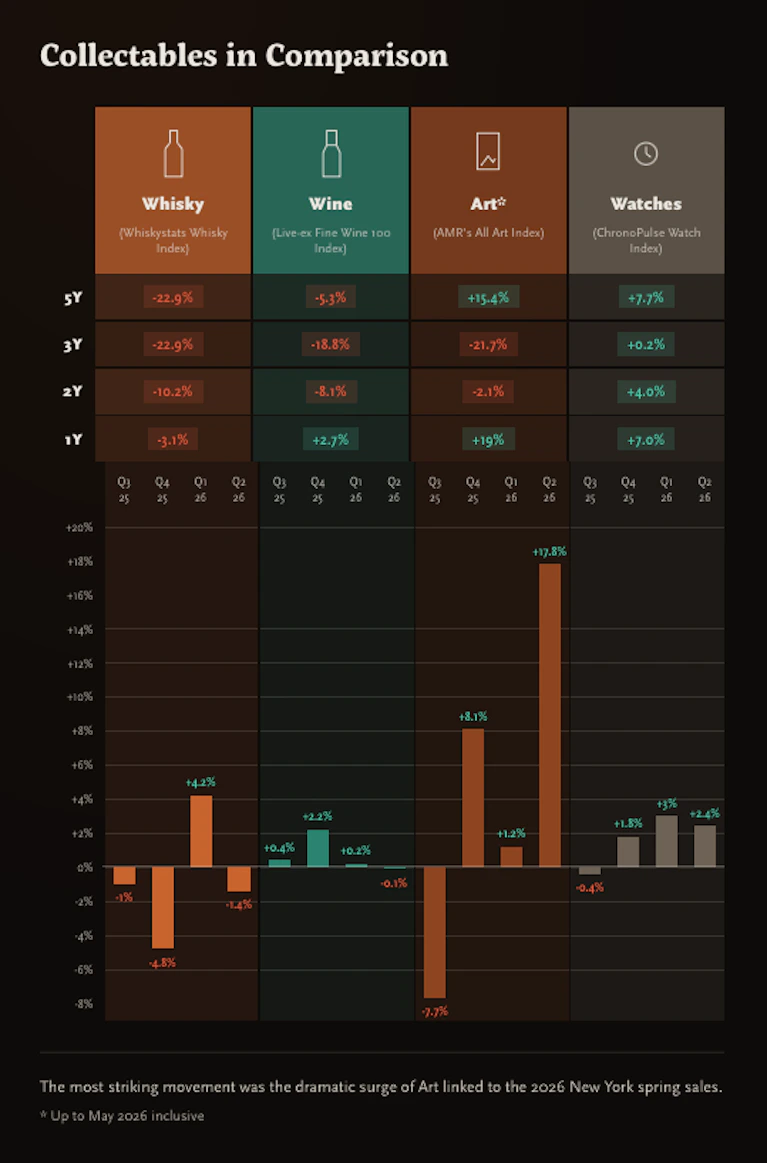
For us, whisky is a "liquid asset" that we view through a long-term wealth perspective. The comparison with other collectables places the whisky cycle in context: sideways movement fits a stabilising market at this stage of the cycle.
Market volatility peaked in April
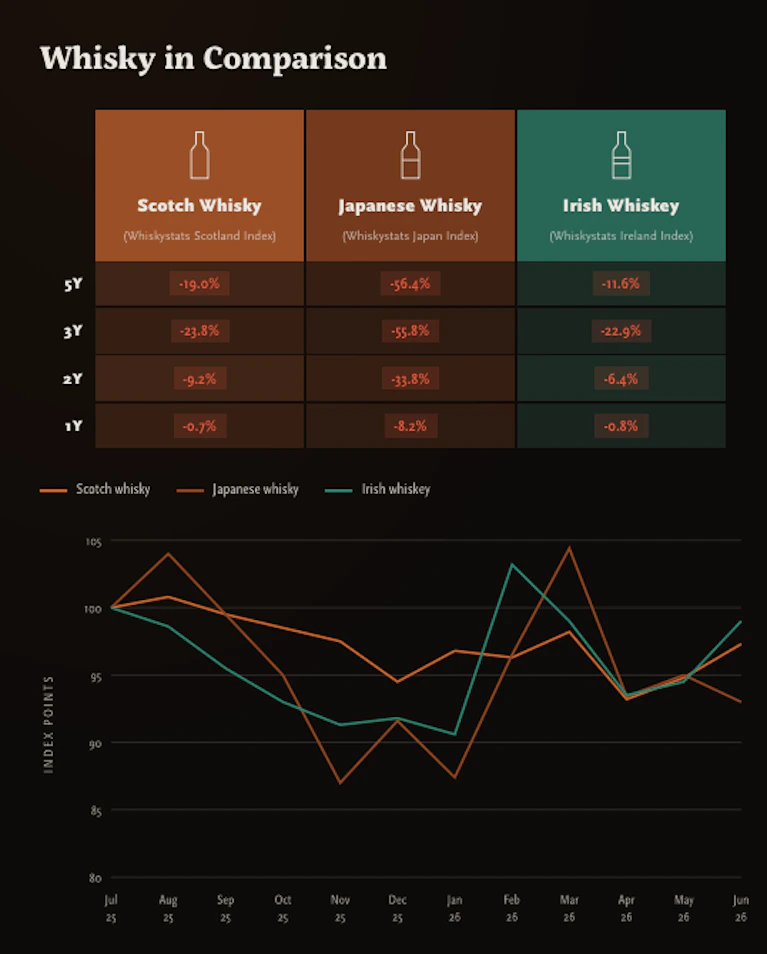
After a solid Q1, the market was hit across the board in April: the Whiskystats Whisky Index fell 4.7% in that month. Scotch declined 5.2% and briefly slipped below the December 2025 level, temporarily making it a new low since the 2022 peak. A recovery followed in May and June.
Irish whisky had built up gains in the preceding months but gave most of them back in March and April. The Irish market recovered again in May and June. Japanese whisky was volatile: a strong comeback in Q1, with February at +13.8% and March at +4.6%, followed by a significant pullback in April. In the subsequent months it remained negative and closed Q2 with a quarterly loss of 10.6%.
In the brand ranking, Macallan came under considerable pressure. From December 2025 through April, the brand swung by around 6% per month in either direction. Stabilisation followed: May +0.1%, June +2.7%. Macallan closed H1 2026 in first place at +0.7% for the half-year. Port Ellen told the opposite story: gains in almost every month, only a modest 1.8% setback in April, and second place at +10.5% YTD at the end of June.
Just after the half-year mark, Port Ellen went on to take the top position from Macallan. More detail on that move is in the July monthly update.
The April correction acted as a stress test, and it was the scarce names with a finite stock, such as Port Ellen, that came through strongest. These Scotch single malts, captured in the Scotland index, are the core of what we watch.
Trading value stops the decline: the floor takes shape
The figures behind H1 2026 are, for the first time in three years, cautiously positive.
In Q1 2026, approximately 84,000 bottles changed hands for a trading value of approximately 26 million euros. A year earlier those figures stood at 86,000 bottles for approximately 30 million euros. Buyers remained price-conscious and cautious, and activity lagged the prior year.
Q2 brought a shift. Auction volume came in at approximately 85,000 bottles, against 79,000 bottles in Q2 2025. Trading value confirms the turn: approximately 25 million euros in Q2 2026, for the first time above the level of a year earlier. Across the full first half, approximately 169,000 bottles changed hands for a combined value of approximately 51 million euros.
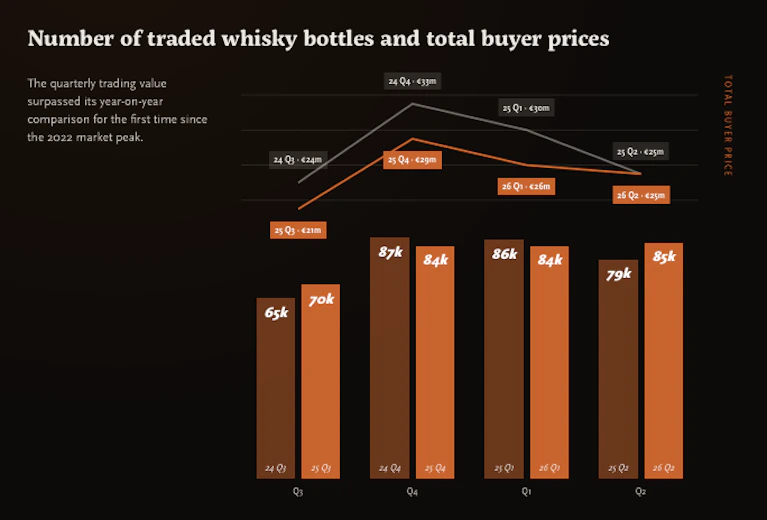
For us, this points to a turning point in the data. Trading value fell for three years; now the direction is turning. We promise no rapid rise, but the signal is clear: the floor appears to have been reached.
We act on signals like these. The direction of trading value is changing for the first time in three years, and in this phase we build targeted positions in scarce names. That is exactly what a base-building phase calls for.
The "hourglass economy": quality over volume
The H1 2026 market is best described as an "hourglass economy": activity concentrates at the two extremes of the price spectrum while the middle is under pressure. The year-on-year Q2 2026 figures by price band make this concrete.
At the entry end, the 0 to 100 euro segment grew 31% in volume and 28% in value. The 100 to 250 euro segment rose 17% in both measures. Beyond that it flattens sharply: 250 to 500 euros recorded only 4% to 5% growth. The 500 to 1,000 euro segment was virtually flat. The most compressed segment was 1,000 to 2,000 euros: it fell 8% in volume and 7% in value, the squeezed middle of the hourglass. At the upper end, the segment above 5,000 euros rose 10% in volume but 37% in value. That 37% value increase was concentrated in just 392 bottles, illustrating the impact of a small number of exceptionally high-value transactions.
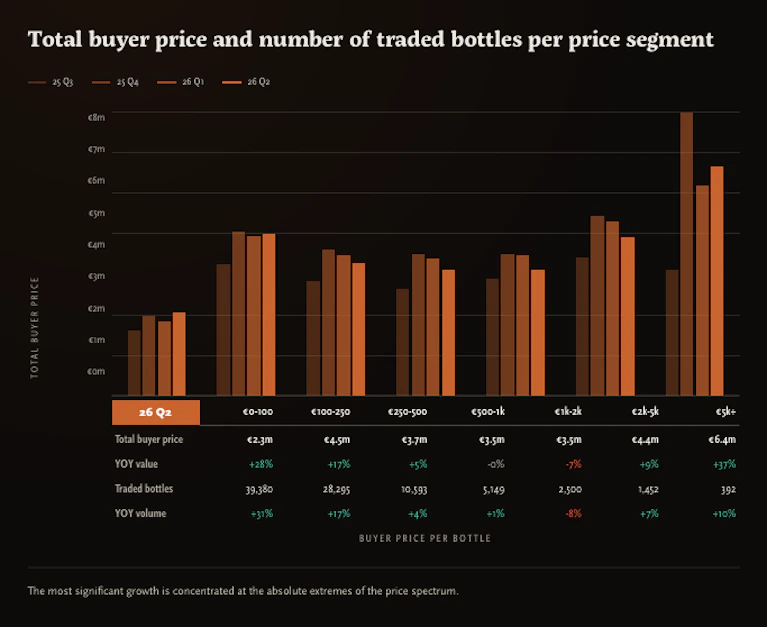
We focus specifically on scarce and rare premium whiskies, the segment where provenance, quality, and scarcity converge. What matters to us are the right bottles and casks. The hourglass dynamic shows why selectivity pays: the middle segment is under pressure, while the top tier holds up. Broad buying tracks the market average; targeted selection can turn that dynamic to your advantage. That is the discipline we apply. Within the top segment, incidentally, not every bottle is equal, and strong quarterly figures in a narrow segment say little about price over the longer term.
Quality remains decisive
The market can be read not only by price segment but also by quality score on Whiskybase. That two-dimensional view makes clear that quality, measured by independent assessments, tracks closely with market performance.
In the top rating segment, Whiskybase 90 to 95, growth in trading value exceeded growth in volume. Concretely: the segment above 5,000 euros translated a volume increase of around 11% into a value increase of around 33%, a multiplier explained almost entirely by the presence of highly rated bottles.
In the softer mid-segments, losses were concentrated in lower-rated bottles. In the 250 to 500 euro segment, the decliners were most heavily represented in the 85 to 86.9 score category; bottles rated 87 and above stayed stable or grew. In the 500 to 1,000 euro segment, volume and value fell in the 85 to 89.9 score category but rose above the 90 threshold. The exception to that pattern was the 1,000 to 2,000 euro segment: it fell across all rating categories, even for scores of 90 to 95 (volume -9%, value -8%). That illustrates that the hourglass effect does not affect every segment in the same way.
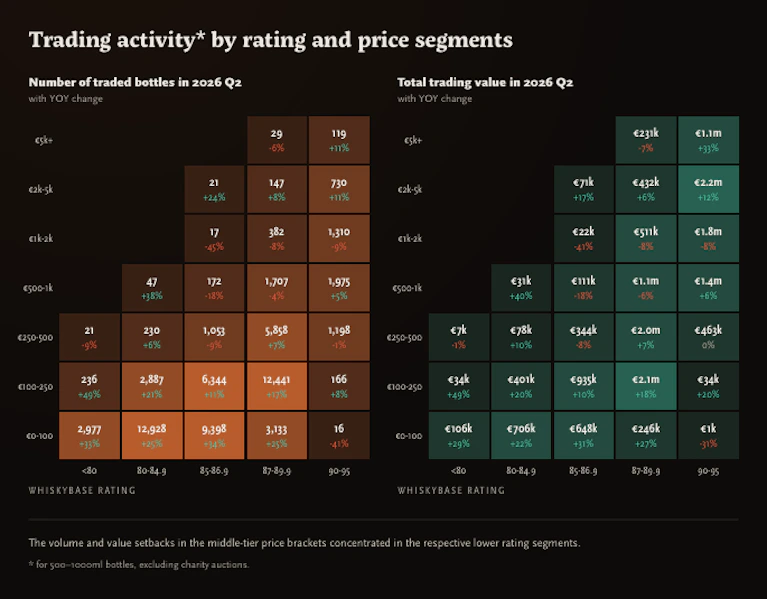
That quality and market performance track each other so closely reinforces our use of independent ratings as a filter. A bottle's rating and provenance weigh more with us than the name on the label.
At the top: records and reality checks
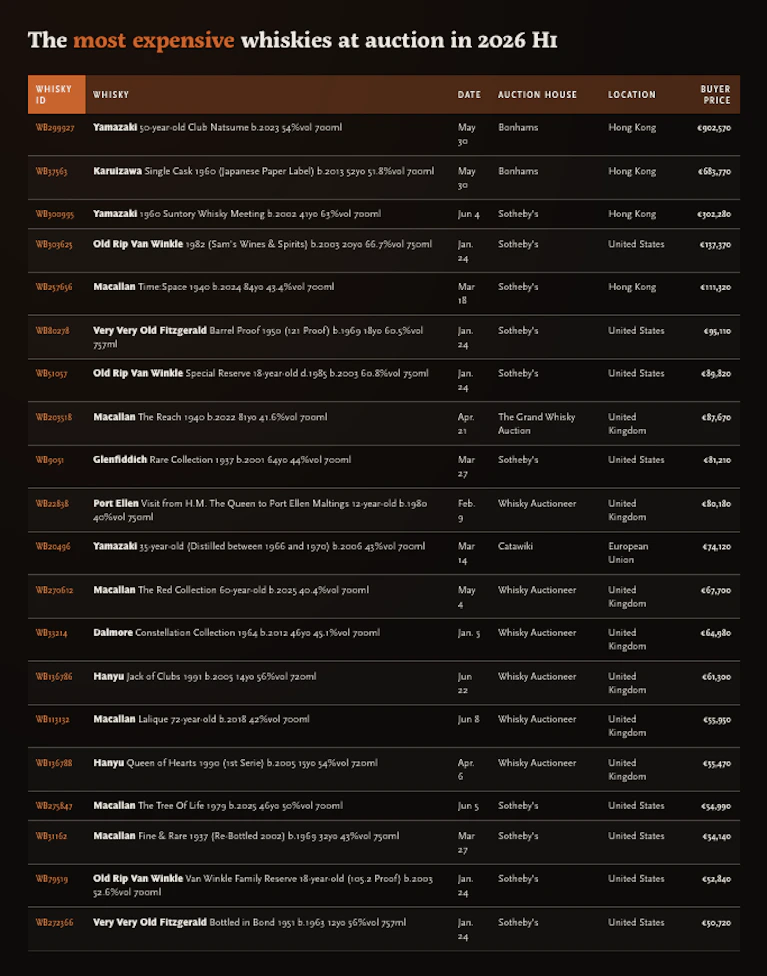
The auction market in H1 2026 showed both ends of the hourglass at once. At the upper end, records reached sums only exceptional material commands; at the other, the market corrected overly ambitious primary pricing.
On 30 May 2026, the Yamazaki 50-year-old Club Natsume fetched over 900,000 euros at Bonhams Hong Kong, a new global auction record for Japanese whisky. A few weeks earlier, in early June, a Yamazaki 1960 Suntory Whisky Meeting (one of 36 bottles) realised approximately 280,000 euros at Sotheby's Hong Kong. That both records fall in the same quarter the Japanese whisky index declined 10.6% illustrates how far the absolute top end can diverge from the broad market average.
A sobering counterpart was the Macallan Time:Space 1940, aged 84 years and priced at around 175,000 euros at release. The bottle failed to attract a buyer five times before finally selling at Sotheby's Hong Kong for 111,320 euros. A disciplined secondary market corrects even the most prestigious names when the primary price is set too far above market value.
Ultra-premium whisky also shows geographic price differences that are relevant to investors. A Karuizawa 1960 52-year-old fetched 683,770 euros at Bonhams Hong Kong on 30 May. Weeks later, a bottle of the same release changed hands in the United Kingdom for 260,800 euros at Whisky Auctioneer on 22 June. Location, timing, and the buyer pool together determine the outcome.
At the level of everyday auction activity, the most traded bottles of H1 2026 were the Springbank 15-year-old and the Springbank 10-year-old, the backbone of the market's daily liquidity. Also prominently featured were Macallan Harmony Collection (Rich Cacao and Intense Arabica), Hibiki 21, Lagavulin 16, and Ardbeg For Discussion 8-year-old.
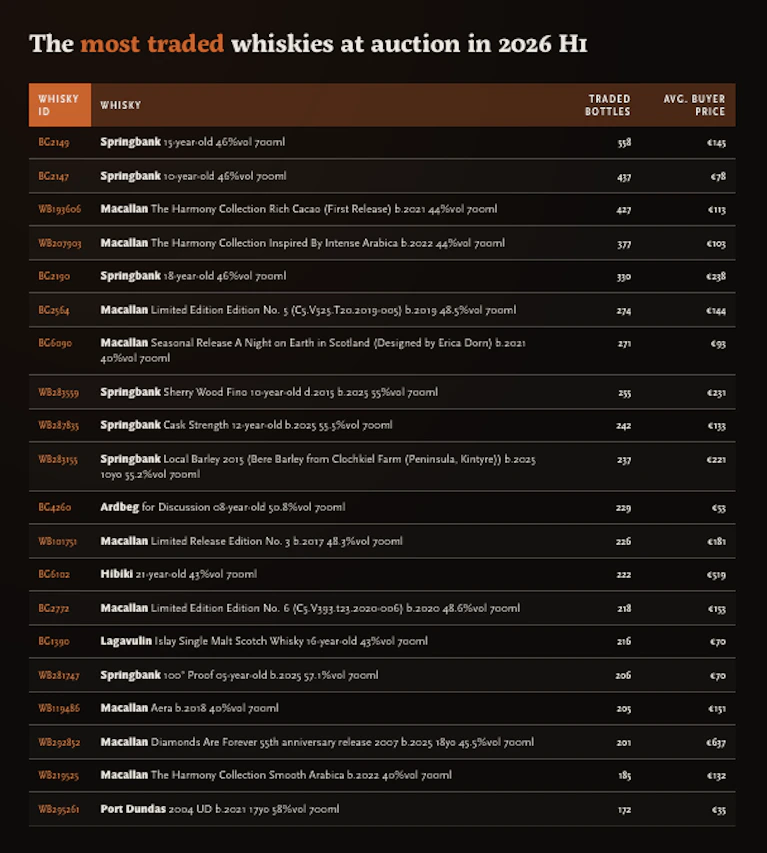
Where the headlines chase Japanese record sales, we deliberately stay with Scotch single malt: scarcity with verifiable provenance builds value more predictably than record hype. A disciplined auction market, one that penalises inflated primary prices, works in our favour; it rewards exactly the bottles we focus on.
Supply: today's production pause lays the groundwork for scarcity
Major producers responded to lower demand in H1 2026 by reducing production volumes and cutting costs. Diageo cut its workforce by nearly 2,000 people, over 6%, and under new chief executive Dave Lewis aims to save 1 billion dollars in costs over three years. Ian Macleod Distillers, owner of Glengoyne and Rosebank, saw revenue fall 8% and profit before tax drop 45.8%; production at both distilleries was cut by around 30%. Brown-Forman reduced its global headcount by 12%. Pernod Ricard announced structural savings of around one billion euros.
What is not distilled today cannot be a 12-year-old whisky in 2038 or an 18-year-old in 2044. The production pause of today lays the groundwork for tightness in the future, which may support the valuation of already-matured stocks over time. That mechanism is historically documented; the timing and scale of the effect simply cannot be calculated in advance.
The "Great Cull" of 1983, when dozens of distilleries were closed, including Port Ellen, was an industry restructuring at the time. In retrospect, it marked the start of a period of exceptional scarcity for those specific whiskies. The fact that Port Ellen leads the brand ranking in H1 2026 makes that connection tangible. Historical scarcity generated real value; whether the current production cuts repeat that, time will tell.
Today's production pause sets tomorrow's scarcity: every cask not filled is a bottle that will not exist. That makes existing, well-documented stock more valuable as the years pass, and it weighs on what we build today.
Demand: trade policy as a tailwind
Three tariff agreements came together in the first months of 2026 and provide context on the demand side.
The UK-India trade agreement came into force on 15 July 2026. The Indian import duty on Scotch whisky fell from 150% to 75% and will be reduced in stages to 40% over a period of ten years. India is one of the largest whisky markets in the world; access at lower tariff rates structurally enlarges the addressable volume. We explored what India's rise could mean for long-term whisky demand in our analysis of the Knight Frank Wealth Report 2026 and the Indian whisky market.
China halved its import duty on Scotch from 10% to 5%, effective 2 February 2026. A more modest measure, but a signal of recovering trade relations for a market that had been under pressure in previous years.
The most direct near-term tariff change concerned the United States. From 24 July 2026, the 10% US import tariff on Scotch whisky was lifted. The US represents around 933 million pounds in export value for Scotch in 2025, the largest export market. A zero tariff lowers the barrier for American importers and consumers. Further background on this agreement is available in our earlier article on the zero tariff for Scotch whisky in the US.
These tariff agreements outline the structure of longer-term demand. We mention them because they shape the conditions for the primary market, which can in turn feed through to the auction market over time.
The Scotland index: what we look at
Because we focus exclusively on Scotch single malt whisky, we look specifically at the Whiskystats Scotland index. Over the past twelve months the index is essentially flat, down 0.7% on an annual basis. Over longer horizons it reflects the correction the market has been through: 9.2% lower over two years, 23.8% over three years, and 19.0% over five years.
In April the Scotch index fell 5.2%, briefly a new low since the 2022 peak, before recovering in May and June. The twelve-month movement of 0.7% confirms the sideways, base-building pattern that characterises phase 4 of the whisky cycle.
A floor that has held for over a year and trading value that for the first time in three years exceeds the prior year level: those are the two data points that confirm the picture we sketched in October 2025. Sideways movement at a stable level is what base-building looks like.
The Scotland index is an orientation point for us. It shows which phase of the market cycle we are in and how specific names and categories compare; we do not mirror our portfolio to it mechanically.
What the first half of the year confirms
The line over the past quarters is consistent. In October 2025 we outlined a market finding its footing. In the monthly updates of June and July 2026, the first confirmations became visible.
H1 2026 provides the most comprehensive evidence to date. The floor in the Scotland index has held for more than a year. Trading value in Q2 exceeded the prior year for the first time in three years. Port Ellen established itself as the strongest-performing top brand of the half-year, with gains in almost every month.
We sketched this picture a year ago; H1 2026 confirms it, now backed by more data points. The transition from phase 3 to phase 4 is clearly taking shape: from correction to base-building. A new growth phase has not begun, and we do not claim otherwise.
What this means for the whisky investor
Base-building phases are historically the periods in which the foundation for returns is laid: positions are carefully built, with attention to quality, provenance, and diversification. We are convinced that whoever builds selectively now is well positioned for the next phase of the cycle.
For investors with a long-term horizon, this is more a phase to expand positions than to reduce them. What that means for your situation depends on your objectives and risk appetite; we provide personal advice only after a conversation in which we understand them. Our market view, in any case, is clear, and we are glad to share it.
Investing in whisky carries value, liquidity, and timing risk: the value of a bottle or cask can fluctuate, a sale is not always immediately achievable, and the timing of purchase and sale affects the outcome. Past performance is no guarantee of future results.
About Scotch Whisky Investments
Scotch Whisky Investments has specialised in investing in Scotch single malt whisky since 2002. We manage over 350 million euros in assets and have operated under AFM licence since 2014. More than 1,600 investors build a portfolio of physical bottles and casks through us, retaining legal ownership while we handle the specialist work, from selection and provenance verification to storage in Scotland. Want to know more about what a whisky portfolio could look like for you? Feel free to arrange a no-obligation introductory meeting.
This information is general in nature and does not constitute personal financial advice. Investing carries risks, including value fluctuations and limited liquidity. Past performance is no guarantee of future results.
Frequently asked questions
How did the whisky market perform in the first half of 2026?
The Whiskystats Whisky Index rose 4.2% in Q1 and fell 1.4% in Q2 2026, with April experiencing a market-wide decline of 4.7%. Across the full first half, approximately 169,000 bottles changed hands for approximately 51 million euros. Trading value in Q2 exceeded the prior year for the first time in three years. For us, the correction phase therefore appears to be over, with the market reaching its floor. We promise no rapid rise and see no new growth phase yet.
What was the impact of the April dip and is it over?
In April 2026 the market fell 4.7% across the board. Scotch lost 5.2% and briefly touched a new low since the 2022 peak. Japanese whisky was hardest hit and closed Q2 at -10.6%. A recovery followed in May and June. The April move was a setback within an otherwise stabilising period, not the start of a new decline. Whether further volatility follows is not predictable.
Has trading value really stopped declining?
In Q2 2026, auction market trading value exceeded the level of the same quarter a year earlier for the first time in three years. For us, this points to a turning point in the data: the decline appears to have stopped. We promise no rapid rise, but in our view the correction phase is behind us.
How did Port Ellen and Macallan perform in H1 2026?
Macallan closed the first half of the year in first place in the Whiskystats brand ranking at +0.7% YTD. Port Ellen stood in second place at +10.5% YTD, making it the strongest-performing top brand of H1. In almost every month of 2026 Port Ellen recorded a gain; only in April did it experience a modest setback of 1.8%. Just after the half-year mark, Port Ellen went on to take the top position from Macallan.
What does the "hourglass economy" say about quality and segment?
The market in H1 2026 had two growing extremes and a contracting middle. The top segment above 5,000 euros rose 10% in volume but 37% in value. The 1,000 to 2,000 euro segment was the weakest, at -8% in volume and -7% in value. Quality ratings reinforce that picture: bottles with a Whiskybase score above 87 remained stable or grew, while lower-rated bottles represented the decliners. In this climate, choosing the right bottle makes the difference.
Is this a good time to invest in whisky?
Base-building phases are historically the periods in which positions are carefully built. For investors with a long-term horizon, this may be a phase to consider expanding positions rather than reducing them, depending on individual circumstances and objectives. Whether that applies to you is something to discuss with an adviser. Investing in whisky carries value, liquidity, and timing risk. This is not personal advice.
Read more
Related articles
Whisky Monthly Update July 2026: Port Ellen overtakes Macallan
The whisky auction market cooled slightly in July, but the index rose for the third month running. Port Ellen takes the top spot from Macallan and Brora makes a striking jump. The Whiskystats figures for July 2026.
Read article
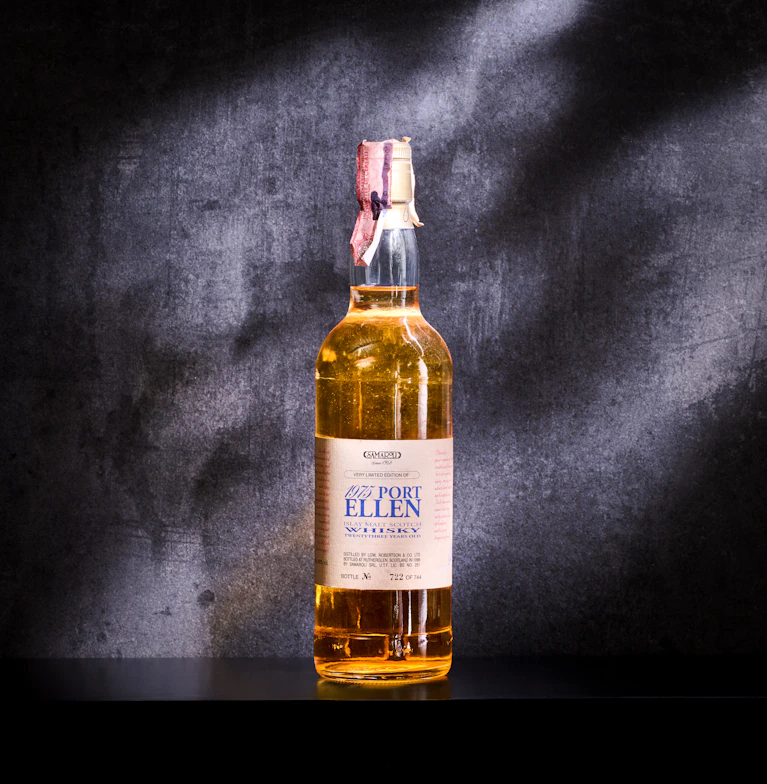
Whisky Monthly Update June 2026: bottom holds steady for a year
The secondary whisky market closed the first half of 2026 on a quietly positive note. In this update, the key figures for June, and how they fit the picture we outlined earlier this year.
Read article
The whisky market seems to regain its balance
The whisky market shows signs of recovery as a new balance between supply and demand emerges, marking a shift toward a more mature market structure.
Read article
Ready to start investing in whisky?
Schedule a no-obligation call with one of our whisky experts.