
Whisky Monthly Update June 2026: bottom holds steady for a year
The secondary whisky market closed the first half of 2026 on a quietly positive note. In this update, the key figures for June, and how they fit the picture we outlined earlier this year.

Stijn de Smit · 10 July 2026 · 4 min read
- Single malt
- Investing
- Whisky
Whiskystats figures June 2026
Almost 29,600 bottles changed hands at tracked auctions, around 4,000 fewer than in May, while total trading value rose from €9.7 to €10.5 million. The Whiskystats Whisky Index (the 500 most-traded whiskies historically) gained 2.6% in market value. Scotch (+3.3%) and Irish Whiskey (+4%) were firmly in the green, while Japanese whisky declined for the third consecutive month (−1.1%), closing the second quarter with a total decline of 10.6%.
Port Ellen leads the way
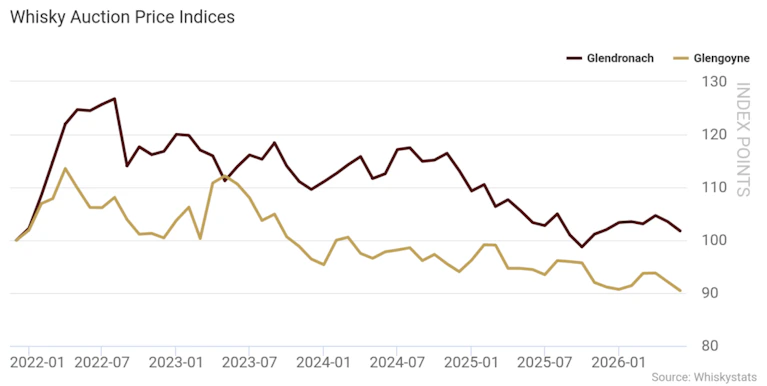
Among the best-performing collector brands, Port Ellen stood out in June. Its index rose in almost every month of 2026, with April the only exception, when the entire market briefly pulled back. In June it added another 3.7%, and year-to-date Port Ellen is up around 10.5%, one of the strongest gainers among the major names. For comparison, Macallan gained 2.7% in June but remained largely flat over the year as a whole, at +0.7%.
Glendronach and Glengoyne miss out
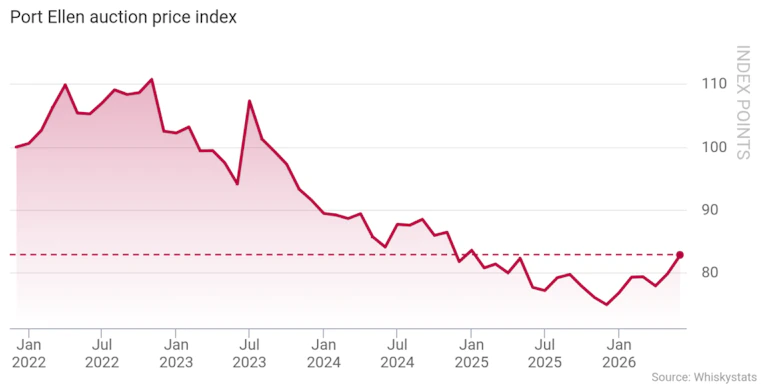
Not every brand shared in the recovery. Glendronach and Glengoyne had actually proved relatively resilient since the market turmoil that began in early 2022: the Glendronach index fell back roughly to its January 2022 level, while Glengoyne lost “only” some 10% over more than four and a half years. Even so, both names lost value in the May and June auction rounds, precisely as the broader market was rebounding from April.
A quietly positive first half
Looking back, the first half of 2026 was, on balance, a quietly positive one for the secondary whisky market. Auction prices stabilised and even rose slightly over the past six months. The only real exception was the sharp pullback in April, when the Whiskystats Whisky Index lost 4.7% in a single round of auctions.
A year of stabilisation, after two years of decline
As a wealth manager focused exclusively on Scotch single malt whisky, we track our portfolio against Whiskystats’ Scotland index specifically: this depicts the value changes of the historically 500 most traded whiskies from Scotland each month, and therefore best reflects our own focus.
On a twelve-month basis, that Scotland index stands at roughly +0.72%, essentially flat, and is up a fraction since the start of 2026, at around +0.5%. This mirrors exactly the pattern we first flagged earlier this year: after two years of sharp corrections, we noted the first signs of a market finding its floor and stabilising. A year on, the figures confirm that picture: the market is moving sideways, at a lower but calmer level, with more maturity on both the buyer and seller side.
The nuance still matters: these are broad index figures, not a guarantee for any individual bottle or cask. Value development varies by name, release, and timing.
Conclusion
For the long-term investor, what matters is not any single month’s headline, but the broader picture: a market that, after two years of decline, has now been stabilising for a year. For investors with a long time horizon, such a stabilisation phase, following a period of correction, can represent an interesting entry point, though this always depends on the individual investor’s situation and objectives. Within that market, selection remains decisive: provenance and rarity matter. Not every bottle moves with the broader index; it is the carefully chosen, scarce names with verifiable provenance that make the difference over the long term. Quality over quantity remains the core principle.
About Scotch Whisky Investments
Scotch Whisky Investments has specialised in investing in Scotch single malt whisky since 2002. We manage over €350 million in assets and have operated under AFM licence since 2014. More than 1,600 investors build a portfolio of physical bottles and casks through us, retaining legal ownership while we handle the specialist work, from selection and provenance verification to storage in Scotland. Want to know more about what a whisky portfolio could look like for you? Feel free to arrange a no-obligation introductory meeting.
This information is general in nature and does not constitute personal financial advice. Investing carries risks, including value fluctuations and limited liquidity. Past performance is no guarantee of future results.
Frequently asked questions
How did the whisky market perform in June 2026?
In June, almost 29,600 bottles changed hands at tracked auctions, around 4,000 fewer than in May, while total trading value rose from €9.7 to €10.5 million. The Whiskystats Whisky Index gained 2.6% in market value.
What does the Whiskystats Scotland index show?
On a twelve-month basis the Scotland index stands at roughly +0.72%, essentially flat, and is up around +0.5% since the start of 2026. After two years of corrections, the market has been moving sideways for a year, at a lower but calmer level.
Is now a good time to invest in whisky?
For investors with a long time horizon, a stabilisation phase following a correction can represent an interesting entry point. However, this always depends on the individual situation and objectives. Investing carries risks and past performance is no guarantee of future results.
Does every bottle move with the index?
No. Index figures are broad and are not a guarantee for any individual bottle or cask. Value development varies by name, release and timing; provenance and rarity are decisive for long-term returns.
Why does Scotch Whisky Investments focus on the Scotland index?
Because we focus exclusively on Scotch single malt whisky. The Scotland index (the 500 most-traded Scotch whiskies historically) therefore best reflects our portfolio focus.
Read more
Related articles
How might US and EU tariffs impact the Scotch whisky market?
De VS legt momenteel geen invoerrechten op Schotse single malt whisky op. Het vorige tarief werd voor een periode van 5 jaar opgeschort en loopt af in juni.
Read article

Wealth growth, India and whisky as an investment
What the Knight Frank Wealth Report 2026 and the UK-India trade agreement mean for investors in Scotch single malt whisky.
Read article

What does geopolitical uncertainty mean for whisky as an investment? An analytical view of the whisky market, trade tariffs and why casks simply keep maturing.
Read article
Ready to start investing in whisky?
Schedule a no-obligation call with one of our whisky experts.