
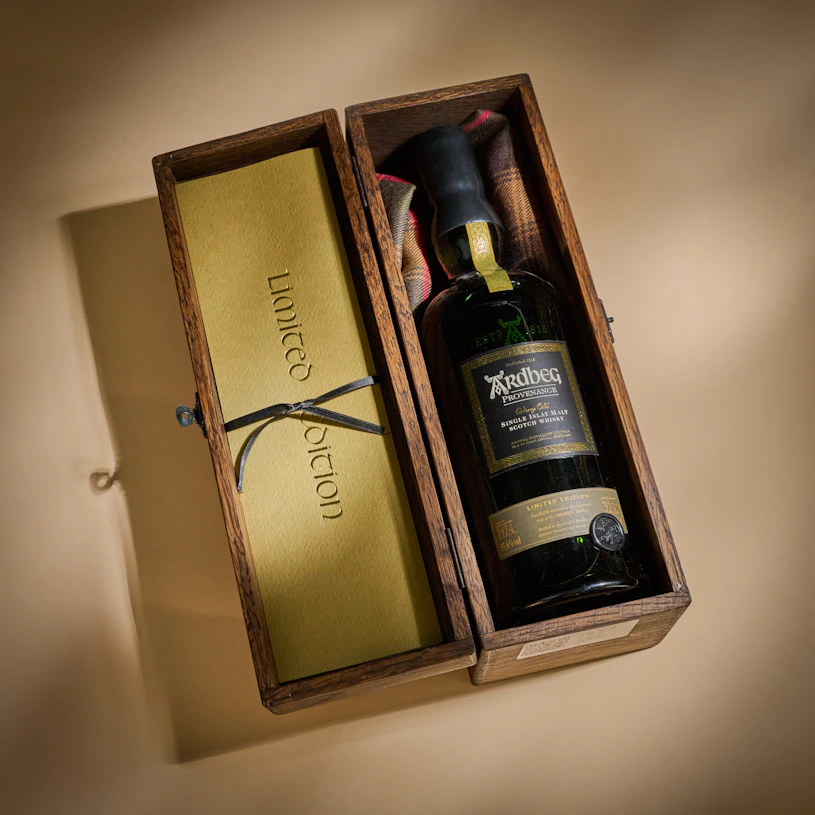
Whisky Monthly Update September 2026: Ardbeg accelerates, India halves its tariff
After the quiet summer months, trading on the secondary whisky market picked up again in September. The Whisky Index rose for the fifth month in a row, Ardbeg posted its largest monthly gain since 2019 and Port Ellen widened the gap to Brora and Macallan. In India, the first price cuts are becoming visible following the trade agreement with the United Kingdom.

Stijn de Smit · 8 October 2026 · 7 min read
- Investing
- Single malt
- Whisky
Market picture, September 2026
In September, 27,300 bottles of 14,200 different whiskies changed hands at the auctions tracked by Whiskystats. After July and August, traditionally the quietest months of the year, activity is picking up again.
The Whiskystats Whisky Index, which tracks the 500 most-traded whiskies historically, closed September at 218.90 points: up 1.01% over the month and 4.16% for 2026. It is the fifth consecutive monthly rise.
As we focus exclusively on Scotch single malt whisky, we look specifically at the Scotland index. It stood at 209.83 points at the end of September, against 210.52 at the end of August. That is a slight decline of 0.33% over the month; for 2026 the index is up 2.64%. After an above-average rise in August, Scotch whisky therefore moved slightly against the broader market in September. The brand figures below show how varied the picture within Scotland is: the gains of Ardbeg and Port Ellen are offset by declines at Brora and at Macallan, one of the most-traded Scotch brands. A single month says little about the longer-term direction.
The share of unsold bottles fell to 8.3%, the lowest level since May. After August's decade high of 10.6%, that is an improvement, although the share remains high in absolute terms. Last month's picture therefore still holds: the market is buying selectively, and what meets demand finds a buyer at rising prices.
This is consistent with the base-building we described in our half-year update and followed further in the August monthly update.
One note on the figures: the Whiskystats indices track only the bottle auction market. Casks are not traded there and so fall outside these figures.
Ardbeg: largest monthly gain since May 2019
The Ardbeg index, based on the 100 most-traded Ardbeg releases historically, has, like the broad Whisky Index, been in positive territory for five months. From May through August the index gained 4.5%, recovering the loss from April's market-wide decline. The September auctions added a further 7.5%, Ardbeg's largest monthly gain since May 2019.
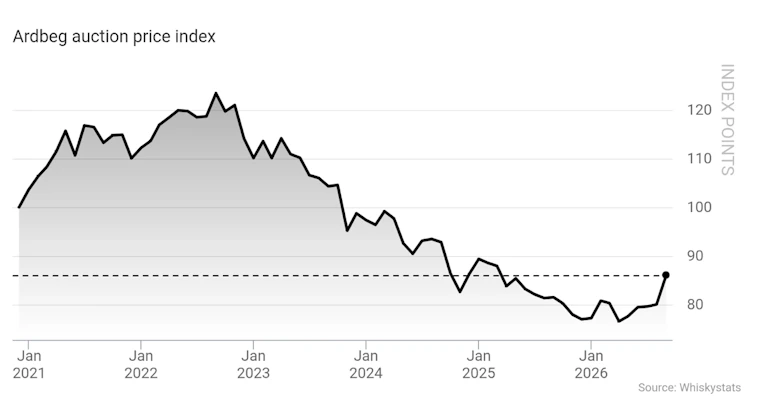
Seen over a longer period, the jump remains modest: the Ardbeg index is still around 30% below its peak of late 2022. Ardbeg is one of the Islay names collectors have followed for decades, The distillery was largely silent from 1981 and ran only on a limited basis until Glenmorangie took it over in 1997, which makes whisky from the period before scarce. Bottlings from those classic periods are also part of our own bottle stock. One strong month is not a trend. The move does, however, fit the pattern the market showed this summer: names with a long track record and a limited supply of older bottlings are the first to recover.
Port Ellen extends its lead, Macallan lags behind
Port Ellen continues to lead the Whiskystats brand ranking. In September, the 77 Port Ellen releases traded gained 2.3% in aggregate, bringing the Port Ellen index to 17.1% for 2026, according to Whiskystats. Brora, which overtook Macallan in August, lost 0.9%. Macallan fell 1.6%. The gap between Port Ellen and the brands in second and third place has therefore widened further.
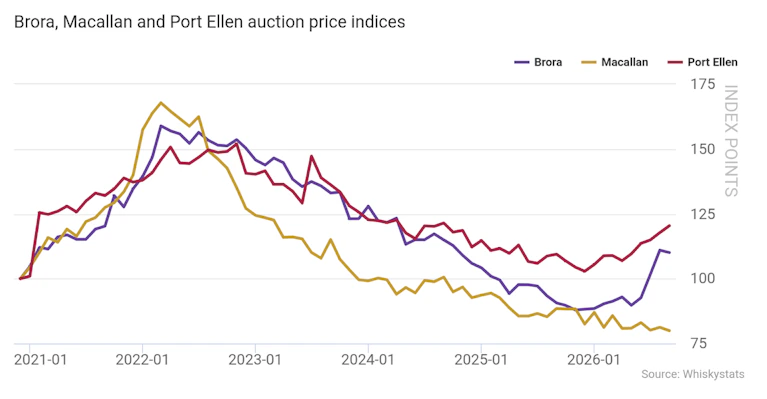
Brora's dip follows an exceptionally strong summer, with gains of 9.6% in July and 9.3% in August. A slight correction after such a period is not unusual.
Macallan is the notable exception to the wider recovery. While Port Ellen, Brora and Ardbeg posted their first value gains in years this summer, the Macallan index stayed broadly flat, and in September it slipped slightly. Measured against early 2021, Port Ellen now stands around 20% higher and Macallan around 20% lower. Whether Macallan joins the upward move during the coming peak auction season is one of the points we will be following in the months ahead.
The difference between Port Ellen and Macallan illustrates a point we make more often. Port Ellen closed in 1983. The distillery reopened in 2024, but new Port Ellen will not reach thirty years of age until around 2054. The whisky from before the closure is finite and diminishes with every bottle opened; bottlings of it are also represented in our own stock. Macallan has kept producing throughout and brings a large and still growing supply of new releases to market. For a closed period of production, scarcity is a given; for a continuously active name, it depends on the specific vintage and bottling.
India: what the trade agreement does in practice
On 15 July, the first tariff reduction under the trade agreement between the United Kingdom and India took effect. The import duty on Scotch whisky went from 150% to 75% and will fall further to 40% over the next ten years. The first effects are now visible on the shelf. In states such as Maharashtra, Rajasthan, Goa and Uttar Pradesh, prices of the major brands have been cut by roughly 6% to 15%. A 75cl bottle of Johnnie Walker Black Label, for example, now costs ₹3,800, against ₹4,250 a few months ago. J&B became more than a quarter cheaper in some states, and Pernod Ricard has applied for reductions on brands including Chivas Regal, Ballantine's and The Glenlivet.
That the price does not halve comes down to how it is built up. The duty is calculated on the import value: for a bottle worth €10 at the border, the cost including duty falls from €25 to €17.50, a reduction of 30%. Each Indian state then adds its own excise duty, VAT and trade margins on top of that cost, so the effect on the shelf price is smaller and differs from state to state. Diageo expected beforehand an average price cut of 7% to 9% for its Scottish-bottled whisky.
Where the agreement does and does not reach
By volume, India is the largest export market for Scotch whisky. According to the Scotch Whisky Association, the equivalent of 220 million bottles went there in 2025, 15% more than a year earlier. By value, India became the third-largest export market at £286 million, while Scotch still holds only around 3% of the Indian whisky market. The vast majority of that volume is young whisky and blends. That is precisely the segment in which, as we described in the August monthly update, the industry is dealing with a surplus. More sales in India can help work down that surplus and so strengthen the financial position of the industry, including the smaller distilleries where the pressure is greatest.
For old whisky, the picture is different. Anyone wanting to meet demand for premium single malt, in India or elsewhere, needs whisky that has matured for decades. That stock cannot be replenished any faster: a cask that is to be thirty years old in 2056 has to be filled now and left untouched all that time. Growing demand at the top of the market therefore meets a supply that does not grow with it, and that shrinks every year through bottlings and evaporation.
For bottles, a similar mechanism plays out over a longer horizon. Taiwan shows how that can unfold. Blends once dominated there too; over the years single malt grew into one of the most important categories and an active market for older and rare bottlings emerged. The export figures reflect this: in 2025 Taiwan was the sixth-largest export market for Scotch whisky by value, at £233 million, yet it does not feature in the top ten by volume. Relatively little whisky goes there, and on average it is far more valuable. The rapid rise of Indian single malt shows that part of India's consumers are already taking that first step. Whether and when that translates into demand for rare Scotch bottlings cannot be predicted; it is a development of years, not the effect of a single tariff cut.
For the investor in old, documented Scotch single malt, the agreement is therefore not a short-term factor. The UK House of Lords likewise described the agreement earlier this year as a longer-term strategic investment rather than a quick win. It changes nothing about the stock of whisky that is thirty or forty years old today. It does broaden the demand side in the industry's largest export market, while the quantity of old whisky is fixed. Earlier this year we set out the trade agreements with India, China and the United States in our article on the zero tariff.
What this means for the whisky investor
September confirms the direction of recent months: a market that is recovering, but not across the board. The Scotland index gave back slightly and among Scotch brands a clear distinction is emerging. Port Ellen and Ardbeg, names with a limited supply of old whisky, are rising; Macallan, with a large and growing supply, is lagging. For the cask portion of a portfolio, these auction figures are not a direct yardstick, but the underlying principle is the same: value is created where maturation time and scarcity meet.
That distinction is at the core of our approach. We do not select on name alone, but on provenance, maturation period and the extent to which supply is limited. A Scotch Whisky Investments portfolio consists, broadly, of twenty percent exclusive, rare bottles and eighty percent maturing casks, selected for the age they must ultimately reach. Quality over volume: in a market that buys more selectively, that counts for more than in a market where everything rises.
For the investor with a long horizon, our reading of the cycle is unchanged. This is a phase of base-building, in which positions are built up in a disciplined way. We are not forecasting a rapid rise; we position based on where the cycle stands. The coming peak auction season, from October through December, will give more insight into whether the recovery broadens. What that means for your situation depends on your objective and risk appetite.
Considering a position in Scotch single malt? Our whitepaper covers how a portfolio is built, the role of provenance and storage, and the risks that come with this asset class. Request the whitepaper.
About Scotch Whisky Investments
Scotch Whisky Investments has specialised in investing in Scotch single malt whisky since 2002. We manage over €350 million in assets and have operated under AFM licence since 2014. More than 1,600 investors build a portfolio of physical bottles and casks through us, retaining legal ownership while we handle the specialist work, from selection and provenance verification to storage in Scotland. Want to know more about what a whisky portfolio could look like for you? Feel free to arrange a no-obligation introductory meeting.
This information is general in nature and does not constitute personal financial advice. Investing carries risks, including value fluctuations and limited liquidity. The index figures cited are broad market averages and say nothing about the value development of an individual bottle or cask. Past performance is no guarantee of future results.
Sources
Whiskystats Price Update September 2026, "Ardbeg accelerates as prices climb," 7 October 2026
Ron Emler, "Scotch prices fall in India after UK trade deal," 5 October 2026
The Whiskey Wash, "India Halved Its Scotch Tariff, So Why Are Shelf Prices Falling by Less Than 10%?," Mark Littler, 6 October 2026
Scotch Whisky Association, "Scotch Whisky Exports to United States down 15% since tariffs implemented," 2025 export figures, 12 February 2026
House of Lords, International Agreements Committee, report on the UK-India trade agreement
Frequently asked questions
How did the whisky market perform in September 2026?
The Whiskystats Whisky Index rose 1.01% to 218.90 points, the fifth consecutive monthly rise. 27,300 bottles of 14,200 different whiskies were traded, and the share of unsold bottles fell to 8.3%, the lowest since May. The Scotland index, which we look at because we focus exclusively on Scotch single malt, eased 0.33% to 209.83 points and is up 2.64% for 2026. These figures are broad market averages and say nothing about the value development of an individual bottle or cask.
Which whisky brand performed best in September 2026?
Ardbeg, up 7.5% in the September auctions, the brand's largest monthly gain since May 2019. Port Ellen gained 2.3% and leads the Whiskystats brand ranking, up 17.1% for 2026. Brora (-0.9%) and Macallan (-1.6%) lost ground.
How much cheaper does Scotch become in India under the trade agreement?
The import duty was cut from 150% to 75% on 15 July and will fall to 40% over ten years. In the first states, retail prices of the major brands have been cut by roughly 6% to 15%. That is less than the halved tariff suggests, because the duty is calculated on the import value and the states then apply their own excise duty, VAT and margins.
What does the UK-India trade agreement mean for investors in Scotch whisky?
Little in the short term. The extra sales are mainly young whisky and blends, the segment in which the industry has a surplus. Old single malt was filled decades ago and will not increase: growing demand for premium whisky meets a supply there that does not grow with it. Whether and when that feeds through into the pricing of rare single malt cannot be calculated in advance.
Why is Macallan underperforming Port Ellen?
Port Ellen closed in 1983 and only reopened in 2024; the whisky from before the closure is finite and diminishes with every bottle opened. Macallan has always remained active, with a large supply of new releases. While Port Ellen rose 17.1% in 2026, the Macallan index stayed broadly flat this summer and fell 1.6% in September. Within Macallan, too, value development varies widely by vintage and bottling.
Read more
Related articles
Whisky Monthly Update August 2026: where the surplus sits, and where it doesn’t
The auction market had its quietest month of the year in August, with the highest share of unsold bottles this decade. What did sell went for rising prices. This week, the Financial Times published an in-depth analysis of Scotland's whisky oversupply. Both pictures are accurate, and they concern different parts of the market.
Read article
Whisky Monthly Update July 2026: Port Ellen overtakes Macallan
The whisky auction market cooled slightly in July, but the index rose for the third month running. Port Ellen takes the top spot from Macallan and Brora makes a striking jump. The Whiskystats figures for July 2026.
Read article

Whisky half-year update 2026: the market floor takes shape
Since 2002 we have built whisky portfolios for more than 1,600 investors, with over 350 million euros under management. That gives us a direct, inside view of the market. Our conclusion on H1 2026 is clear: after three years of correction, the whisky market appears to have reached its floor. We promise no rapid rise, but in our view the correction phase is behind us.
Read article
Ready to start investing in whisky?
Schedule a no-obligation call with one of our whisky experts.